
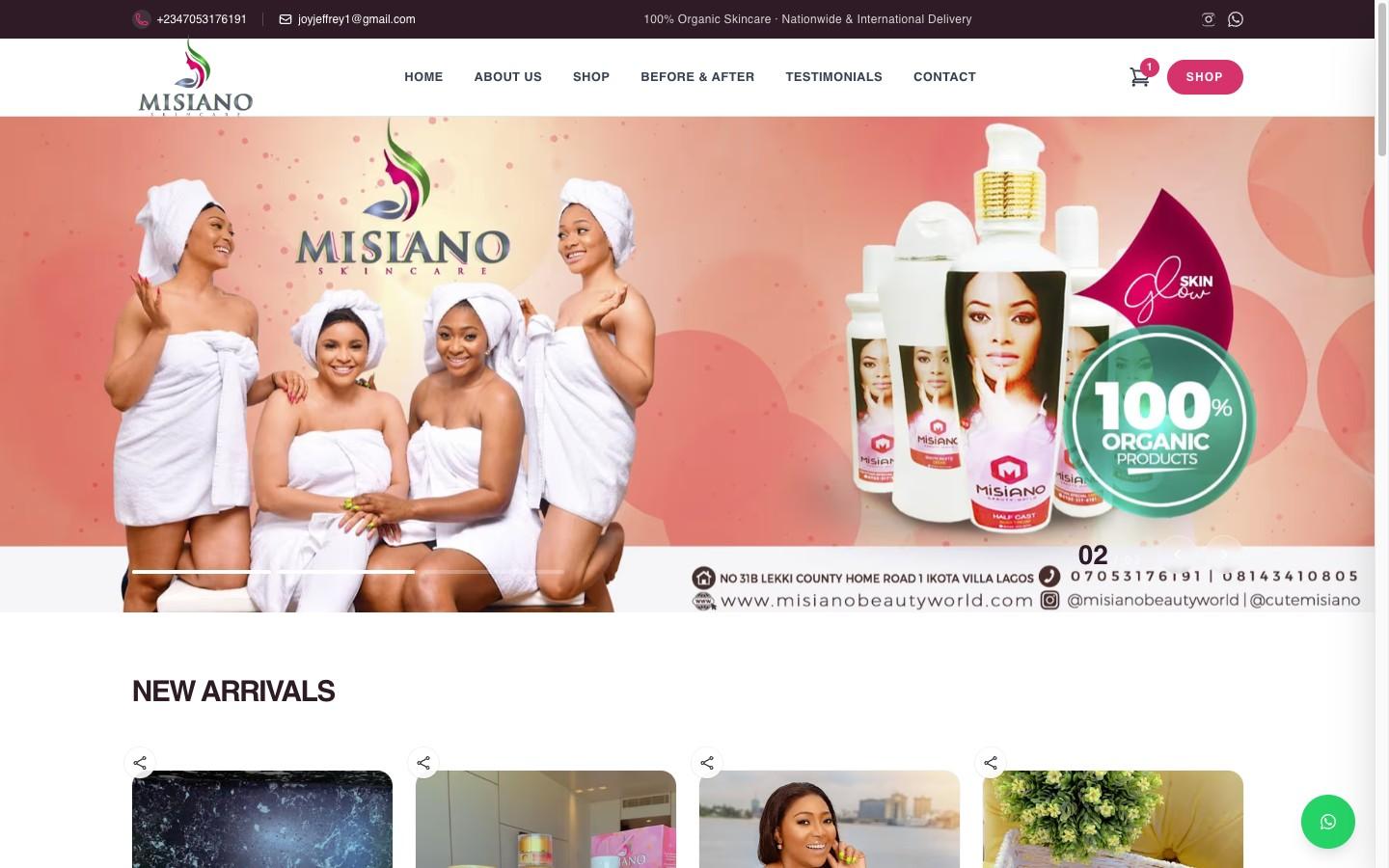
At a glance
Misiano Beauty World is a Lagos-based skincare brand built on a clear promise — “the Number One Skincare Products you can trust,” 100% organic and suitable for all skin types. It had a loyal following and a strong before-and-after story, but no real shop: customers browsed products, then had to tap a “Buy via WhatsApp” button and complete every purchase by hand, one message and one bank transfer at a time.
Inventrium rebuilt misianobeautyworld.com as a genuine self-service storefront — a catalogue of 40+ products, a cart, a secure checkout, Paystack card payments in Naira, and shipping zones for Lagos, the rest of Nigeria and international orders — then put it through a pre-launch hardening pass for security, SEO, accessibility and abuse protection before going live.
We took a beauty brand that sold over WhatsApp and gave it a real online store: browse, add to cart, pay by card, get it shipped, without losing the personal touch that built it.
The brief
Misiano Beauty World sells organic skincare — the Snow White range of soaps and creams, the Glow Cream line, face sets, body scrubs, serums, men’s sets and more — to customers who want natural alternatives to harsh chemical products. The brand’s reputation rests on results and word of mouth: its before-and-after gallery and customer testimonials do the selling.
The problem was the buying. The original site was effectively a catalogue with a phone number: every product carried a “Buy via WhatsApp” button, and orders were closed manually over WhatsApp and phone, with payment by bank transfer and proof-of-payment emailed back for confirmation. That works at small volume, but it caps growth: the owner becomes the checkout, every order needs a live conversation, nothing happens out of hours, and the friction quietly loses the customers who simply want to pay and move on.
The brief was to keep everything that made the brand trusted — the organic positioning, the proof gallery, the warm tone, the WhatsApp line for people who still prefer it — but add the one thing it was missing: a store that takes the order and the money on its own.
Objectives
- Add a self-service checkout as the primary digital path: browse, add to cart, pay by card, without needing a WhatsApp message.
- Stand up a complete product catalogue: the full Misiano range online as a browsable, shoppable shop.
- Take card payment in Naira through Paystack, and keep a bank-transfer option for customers who prefer it.
- Handle delivery honestly: surface shipping cost and timelines up front for Lagos, nationwide and international orders.
- Preserve the brand’s trust signals: keep the before-and-after results, testimonials and organic story front and centre, and keep WhatsApp as an order and enquiry channel.
- Run a pre-launch audit-and-fix pass: security, accessibility, SEO and rate-limiting checks before go-live.
What we did
A cloned storefront with real commerce
The first commit rebuilt the live store on Inventrium’s modular Next.js platform and added the machinery a WhatsApp catalogue never had: a cart, a checkout, Paystack payments and shipping, all in one pass. The shape of the old site was preserved — a banner hero slider, “New Arrivals” and “Featured Products” grids, the before-and-after gallery and a closing call-to-action — but each product is now an item you can add to a basket rather than a prompt to start a chat.
A full, shoppable catalogue
The complete Misiano range — 40+ products across the shop page, from the ₦5,000 Pink Lips Balm to the ₦245,500 Snow White Combo Set — was modelled as a sortable product grid, with the homepage surfacing curated “New Arrivals” and “Featured Products” subsets. The catalogue is content-managed through Sanity, so the brand can maintain products and imagery without touching code.
Paystack checkout in Naira, with a bank-transfer fallback
Checkout settles in NGN through Paystack, taken live with the brand’s production public key so cards are charged for real. For customers who still prefer to pay by transfer, the checkout also carries structured bank-transfer details (Naira and USD/international accounts, with SWIFT/BIC for overseas payers) and the proof-of-payment confirmation flow the brand already used, now built into the page instead of conducted over email by hand.
Shipping zones that tell the truth at checkout
Delivery is modelled as three explicit zones so the customer sees the real landed cost before paying: Lagos (₦5,000, 3–5 days), other Nigerian states nationwide (₦10,000, 3–5 days), and international (₦200,000, 7–21 days). The fee is applied at checkout rather than negotiated afterwards, replacing the old “we’ll let you know the delivery cost” exchange with an upfront number.
Order capture and owner notifications
Orders placed through the store are captured and routed to the brand’s admin email, so a self-service order arrives as a record to fulfil rather than a thread to reconstruct from chat history. WhatsApp stays on the site on purpose, both as an enquiry channel and as an assisted-order route for customers who prefer to buy that way, because it is part of how this brand earns trust. The change is that self-service checkout is now the primary digital path, sitting alongside WhatsApp rather than replacing it.
Keeping the trust signals that built the brand
The work was careful not to strip out what was working. The Before & After gallery and the Testimonials page were carried over as dedicated, image-led pages, the About page keeps the brand’s own voice, and the contact page leads with the Lagos store address, phone lines and WhatsApp. The new commerce sits underneath the existing proof, not in place of it.
A pre-launch audit-and-fix pass
Before launch the site went through a dedicated audit-and-fix pass covering security, SEO, accessibility and rate limiting, the standard go-live checklist for a site that now handles payments and customer data. A follow-up added image loading skeletons so the image-heavy catalogue feels fast, shop sorting so a 40-product grid stays navigable, and a cleaner contact layout, with the live Paystack key wired in for go-live. This was a launch checklist pass, not a full security audit or a penetration test.
Delivered and verified
- A self-service storefront: discover a product, add it to a cart, pay by card in Naira and have it shipped, without waiting on the owner to reply.
- The full range online and self-maintained: 40+ products in a sortable, CMS-managed shop the brand can update itself.
- Live Paystack card checkout in NGN, with the structured bank-transfer option kept for customers who prefer it.
- Honest, upfront delivery: Lagos, nationwide and international shipping priced and timed at checkout.
- Trust carried forward: the before-and-after proof, testimonials, organic story and WhatsApp line all preserved.
- A pre-launch audit-and-fix pass: security, SEO, accessibility and rate-limiting fixes applied before go-live.
How to judge the result
What we can show is the delivered store: the catalogue, the cart, the live card checkout, the shipping zones and the launch-readiness fixes. The number that tells the real story is the share of orders placed in the store rather than over WhatsApp. It builds up in the brand’s own order data month by month, and it is the clearest sign of self-service becoming the main way customers buy.
Checkout and fulfilment boundary
Self-service checkout is now the primary digital path, but it is not the only one and it is not fully hands-off. Card payments through Paystack are verified and captured automatically. Bank transfer still needs the customer to send proof of payment and someone at the brand to confirm it before the order is treated as paid. WhatsApp remains a supported assisted-order channel on purpose. And fulfilment, packing and shipping are still done by the brand. So the win is a real self-service option added alongside the existing channels, not a store that runs itself.
What it means
For customers: there is now a self-service option. Browse the full range, see the real delivery cost up front, pay by card at any hour without opening a chat, or still buy by transfer or over WhatsApp if they prefer. The proof that made them trust the brand sits right alongside the shop.
For the business: card orders arrive as records to fulfil rather than conversations to reconstruct, and the shop can take a card order out of hours. Bank transfers and WhatsApp orders still involve a manual step, so the brand keeps the relationship-led selling it does best while gaining a channel that does not need a live reply.
Strategically: Misiano moves from an informal social-commerce presence to an owned storefront with a real self-service option, built on a modular platform with a CMS so the catalogue and commerce can grow over time.
Why it matters for Inventrium
This engagement shows us taking a beloved but informal brand and giving it a working e-commerce business — full catalogue, cart, secure Paystack checkout in Naira, zone-based shipping and order capture, on a modern, maintainable stack, with a launch-readiness audit before go-live. It is a clear demonstration of the self-service-store upgrade that a large share of Nigerian small businesses need, added alongside the WhatsApp selling they already do.